The Five Selves Theorem: Why Your Brain Treats Future-You Like a Stranger (And How Sealing Reverses It)
"Your brain files your future self in the same neural drawer it uses for strangers. That is not a flaw — it is the problem sealing was invented to solve."
A 2026 framework for understanding why promises to your future self keep breaking — and how a single, sealed, time-locked letter is the only writing practice that actually closes the gap.
You have made the same promise to your future self at least a dozen times. You will sleep earlier. You will text her back. You will save the money. You will be kinder to yourself when this thing is over.
And then the future arrives, and the person who shows up does not honor the promise. Not because they are weak. Because, neurologically, they are not the same person who made it.
This is not a metaphor. It is one of the most replicated findings of the last fifteen years of social neuroscience. And it is the precise problem the Five Selves Theorem — a FutureNote concept — is designed to make visible, and then to solve.
The stranger in the mPFC
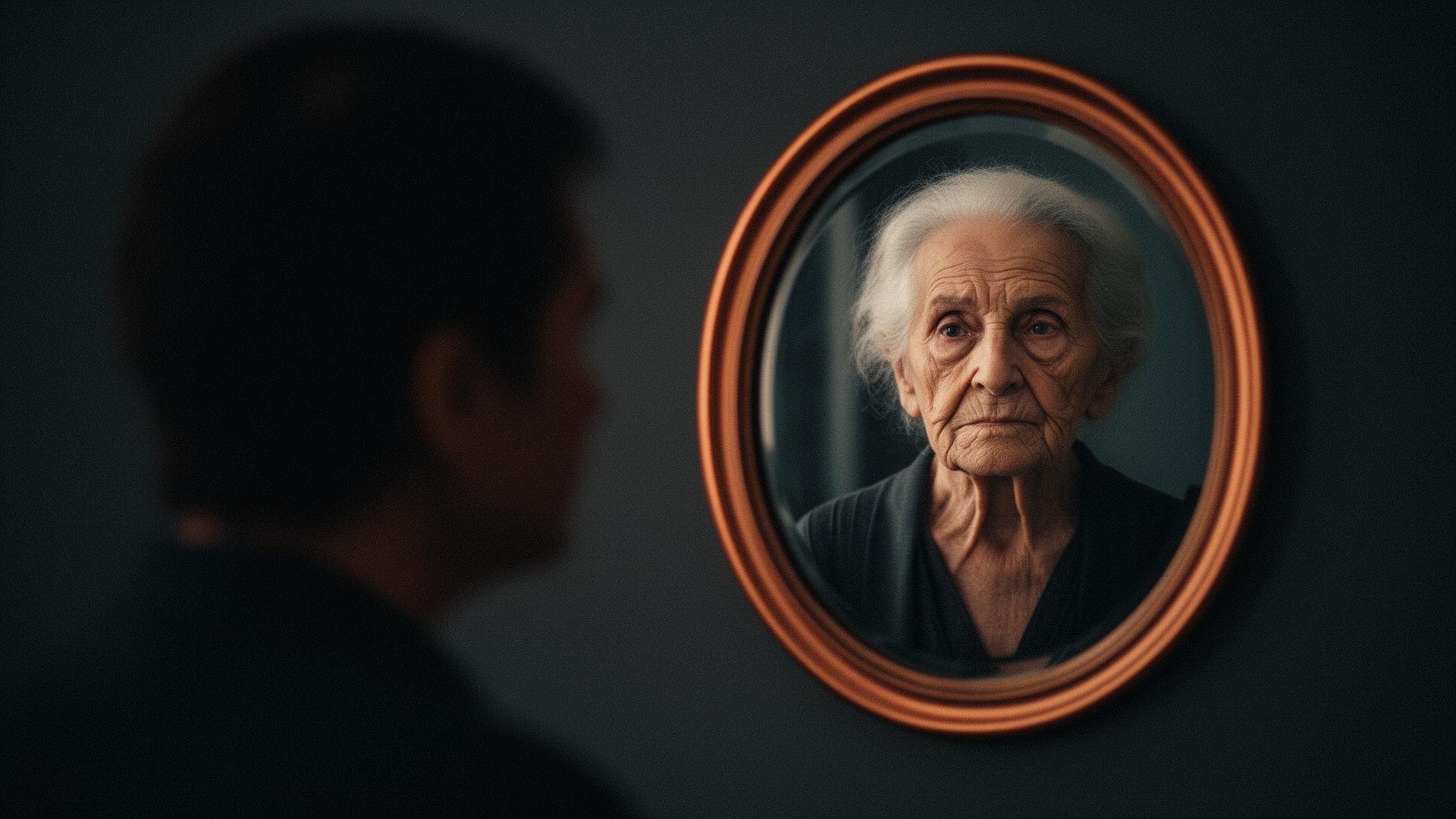
Because to your brain, they roughly are one.
In a now-classic series of fMRI studies, UCLA researcher Hal Hershfield showed that when most people think about themselves now, the medial prefrontal cortex (mPFC) — the brain's "this is me" region — lights up. When the same people think about themselves in ten years, that region quiets down and starts looking like the pattern produced by thinking about a stranger. (Hershfield, 2011)
The neurological term is low future self continuity. The lived experience is more familiar: you make a plan for Future-You and then Future-You arrives and refuses to keep it, because Future-You never agreed to anything. Past-You did. And Past-You is, to the neurons doing the deciding right now, basically a coworker you used to know.
FutureNote Perspective: Most self-improvement advice assumes you are arguing with yourself. You are not. You are negotiating across time with someone your brain has classified as a stranger. The intervention that works is not louder discipline — it is a written, sealed, time-stamped contract that the stranger cannot pretend they never received.

What is the Five Selves Theorem?
The Five Selves Theorem is FutureNote's working model of the inner cast of characters that shows up whenever you write across time. It maps cleanly onto the existing science (Hershfield's continuity work, Kross's self-distancing, Pennebaker's expressive writing) but adds a structural layer the literature does not name out loud.
The five selves are not metaphors. They are functional roles your nervous system actually rotates through.
The Five Selves Theorem (FutureNote, 2026): Every act of sealed writing involves five distinct selves — Past-Stranger, Present-Survivor, Near-Future Self, Far-Future Self, and Returning Reader. Most journaling addresses only one. A sealed letter is the only practice that physically connects all five.
| # | The Self | Time horizon | Neurological signature | What they need from writing |
|---|---|---|---|---|
| 1 | Past-Stranger | Anywhere from 14 days to years ago | Low mPFC overlap with current self — feels like a different person | To be remembered without being rewritten |
| 2 | Present-Survivor | Today, this hour | Maximum mPFC activation, narrow attention, high reactivity | A way to put the worry down |
| 3 | Near-Future Self | 2 weeks – 3 months out | Partial continuity, still negotiable | A clear, witnessed promise |
| 4 | Far-Future Self | 6 months – 1 year out | Stranger-pattern: low continuity, treated as third party | A letter, not a to-do list |
| 5 | Returning Reader | The version of you who breaks the seal | Sudden re-activation of the Past-Stranger pattern + present-day overlay | Evidence of who they used to be |
A journal entry talks to Self #2 (the survivor). A goal-setting app talks to Self #3 (the negotiable near-future). Almost nothing in the modern wellness stack talks honestly to Self #4 — the far-future stranger — and almost nothing builds a deliberate channel for Self #5, the returning reader. That is the gap the sealed letter fills.
How does future self continuity actually work?
Hershfield's research, replicated by labs in Stanford, Kyoto, and Bonn, shows three reliable findings.
- Continuity predicts behavior. People with higher self-reported continuity to their future self save more money, exercise more, and report higher long-term life satisfaction.
- Continuity is malleable. Brief interventions — meeting an age-progressed photo of yourself, writing to a future self, even imagining them in detail — measurably raise continuity scores.
- Continuity decays without input. Left alone, the gap widens. The default is drift.
Pair this with Ethan Kross and Özlem Ayduk's self-distancing work, and a clean picture emerges: the same psychological distance that helps you regulate today's emotion also hurts your ability to plan for tomorrow's self. Distance is the medicine and the disease. The variable that decides which one you get is structured contact across time — exactly what a sealed letter provides.
Why most resolutions fail (the Continuity Gap)
The Continuity Gap is the FutureNote name for the structural distance between the self who makes a promise and the self who is supposed to keep it.
Three forces widen the gap:
- Time — every day without contact lowers continuity another notch.
- Emotional novelty — a major mood shift (good or bad) re-files the past self as someone else's problem.
- Editability — open journals invite revision, which means the original commitment never settles. The brain registers it as still-in-draft.
A New Year's resolution is the worst-case stack of all three. Long horizon. Emotional spike on January 1. Infinitely editable. The promise is made by Self #2 to Self #4, with no witness, no seal, and no scheduled return. Of course it breaks.
Why sealing closes the Continuity Gap
A sealed letter to your future self is not a journal entry with a calendar trick attached. It is a structurally different object, and the difference is what does the work.
Three properties matter.
1. The seal is a witness. The act of locking the note tells your nervous system that the commitment has been received. This is the same closure mechanism we wrote about in vs. journaling — immutability ends the rumination loop because the brain stops treating the entry as still-open.
2. The lock duration crosses the 14-day emotional threshold. That window is the shortest interval at which a returning self can recognize the writer as meaningfully different — distant enough to be heard as a voice from outside, close enough to still feel like family.
3. The unlock activates the Returning Reader. Self #5 only exists if you build a channel for them. Sealing is that channel. Without it, the Past-Stranger never gets a hearing — they are simply forgotten, which is the pattern explored in the memory decay paradox.
FutureNote Perspective: A sealed note is a small, deliberate act of identity diplomacy. You are introducing two strangers — Past-You and Future-You — and forcing them to sit in the same room. Most lives never engineer that meeting. The ones that do tend to feel less like a series of strangers passing through a body, and more like one person.

A 90-day protocol: becoming a stranger to yourself, on purpose
You do not need to seal a letter every day. The point of the practice is the contact, not the volume. The protocol below is what FutureNote users tend to settle into within their first quarter of use.
| Week | Self addressed | Lock duration | Suggested prompt | Why this dose |
|---|---|---|---|---|
| 1 | Near-Future Self | 14 days | "What I want to be true about me in two weeks." | Crosses the emotional threshold; teaches the nervous system the practice |
| 2–3 | Present-Survivor → Far-Future Self | 30 days | "The thing I am most afraid of right now, and what I hope you can tell me about it." | Pennebaker-style expressive writing with delayed delivery |
| 4–6 | Far-Future Self | 3 months | "A gratitude anchor for a future hard day." | Builds a self-authored mental-health lifeline |
| 7–9 | Past-Stranger (via compassionate past exercise) | 30 days | "What I would say to the version of me from one year ago." | Activates the Kyoto 2026 self-compassion mechanism |
| 10–13 | Returning Reader + new Far-Future Self | 6 months – 1 year | "A letter to the person who will read this on my next birthday." | Creates the longest-arc continuity loop |
Twelve sealed letters across ninety days is enough to measurably raise self-continuity in most users. It is also a small enough number that the practice never becomes a chore — which matters, because chore-coded rituals decay first.
What unlocking actually does to your brain
The unlock is the part of the practice almost no one talks about, because almost no other writing tool has one.
When a sealed letter opens, three things happen in quick succession.
First, a continuity spike. The mPFC briefly re-categorizes the Past-Stranger as self, because the handwriting, the worry, the small private references all match. This is the neurological correlate of the small surprised tenderness most users report on first unlock.
Second, a reframing window. For roughly the first read-through, the present-day self can see the past-self's situation with the calm of distance and the intimacy of recognition at the same time. This is the most cognitively expensive — and most therapeutically valuable — state the practice produces.
Third, a narrative integration. The opened letter becomes part of the chaptered record. It joins the Self-Evolution Map and starts contributing to the long-term pattern instead of dissolving into ambient memory.
This is the second wave of insight we have called the Sealing Premium — the part journaling cannot deliver because journaling never closes the loop.

How does FutureNote apply the Five Selves Theorem?
FutureNote was designed around the five selves before we had the name for them.
- One sealed note per day, maximum. Protects the weight of each act for Self #2 and Self #3.
- Lock durations of 14 days, 30 days, 3 months, 6 months, 1 year. Each one calibrated to a specific Self in the model.
- Five permanent Chapters — Inner Compass, Hearts & Echoes, Daily Grit, Raw Reality, Becoming — give the Returning Reader a structured map instead of an undifferentiated feed.
- The Self-Evolution timeline is the only place in the product where all five selves appear in the same view.
The full ritual is on the FutureNote landing page, and the science layer continues in the psychology of writing to your future self.
Frequently asked questions
What is the Five Selves Theorem in one sentence?
A FutureNote framework that names the five inner roles every act of sealed writing involves — Past-Stranger, Present-Survivor, Near-Future Self, Far-Future Self, and Returning Reader — and argues that a time-locked letter is the only writing practice that physically connects all five.
What is future self continuity?
A measurable psychological construct, introduced by Hal Hershfield, describing how similar your present-day self feels to the version of you in the future. Higher continuity predicts better long-term decisions; lower continuity makes future-you feel like a stranger your present-self is not obligated to.
Why does my future self feel like a stranger?
Because brain-imaging studies show that the medial prefrontal cortex — the region that signals "this is me" — quiets down when you think about future-you and starts to resemble the pattern produced by thinking about a stranger. It is a default of the nervous system, not a personality flaw.
How do I become someone who keeps promises to my future self?
Stop relying on willpower across the Continuity Gap. Instead, write a short, specific, time-locked letter and seal it. The seal acts as a witness, the lock duration crosses the emotional threshold, and the eventual unlock gives Returning-You evidence of who Past-You was — which is what raises continuity in the first place.
Is a sealed letter the same as a goal?
No. A goal is addressed to your near-future self and is editable. A sealed letter is addressed to a specific dated self, is immutable once sealed, and is designed to be re-encountered rather than achieved. Goals get checked off; sealed letters get answered.
FutureNote is a mental wellness app built around one ritual: a single sealed letter to your future self, locked for 14 days to a year, opened only when time allows. It is the only writing practice designed around the full Five Selves Theorem — past, present, two flavors of future, and the returning reader who connects them.
Ready to write to
your future self?
Download FutureNote and write your first sealed letter in under 3 minutes. Lock it. Forget it. Rediscover it.
Download on the App Store