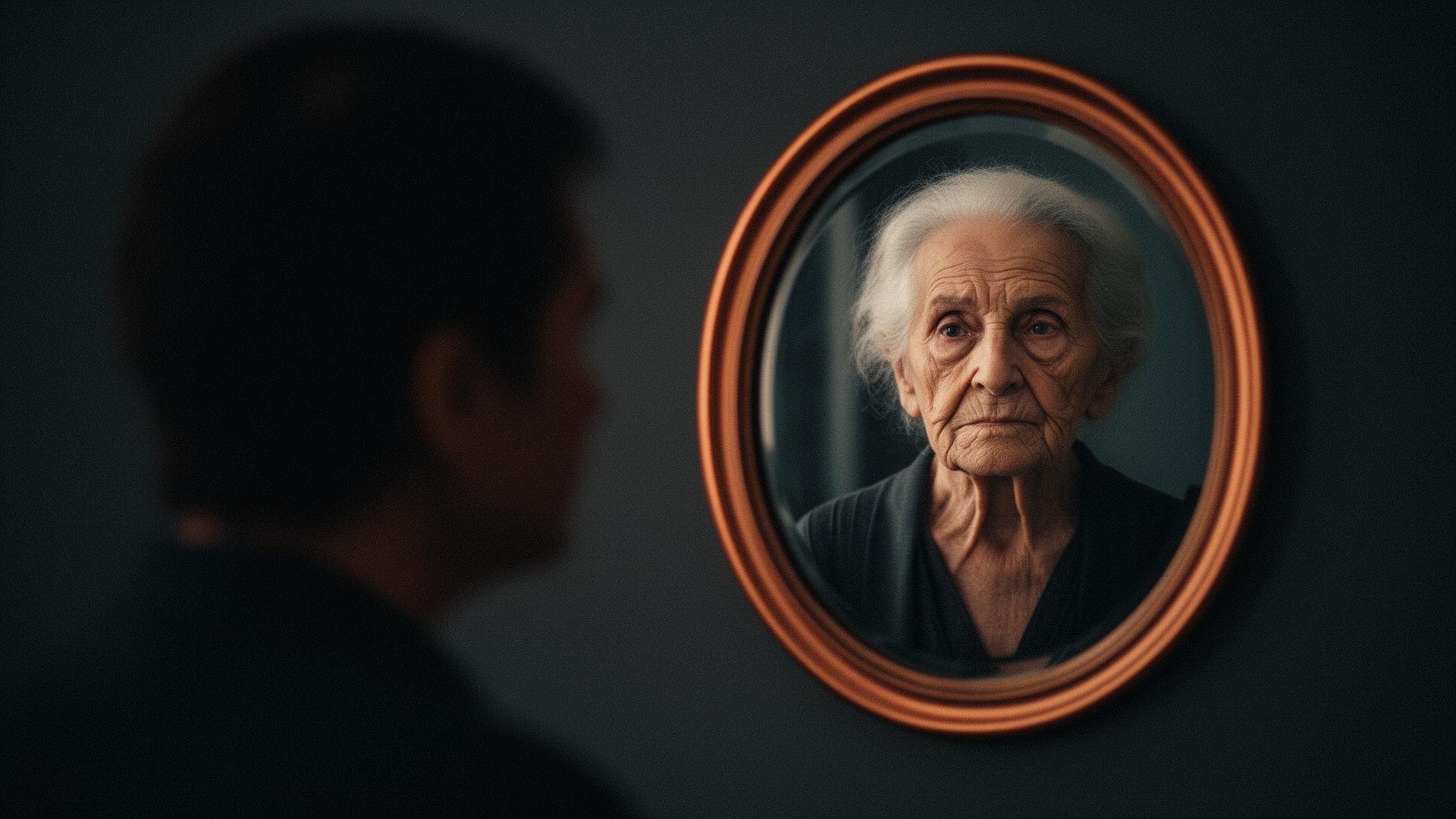
The Memory Decay Paradox: Why Your Happiest Moments Disappear First
"Your brain doesn't delete memories equally. It keeps the scars and discards the sunlight."
Think about the best day of your life. You can probably name it. But can you feel it? Can you remember how your chest felt, what the air smelled like, the exact texture of that joy?
Now think about your worst day. The details rush back uninvited — the room, the words, the weight in your stomach.
This isn't a flaw. It's a feature. And it's quietly shaping your entire self-narrative without your permission.
The asymmetry: scars outlast sunlight
The answer is a survival mechanism that neuroscientists call the negativity bias asymmetry — but we call it the Memory Decay Paradox: the phenomenon where positive emotional memories lose their vividness 3–5x faster than negative ones.
Your brain doesn't delete memories equally. It keeps the scars and discards the sunlight. This isn't pessimism — it's your amygdala doing its job.
Your amygdala — the brain's threat-detection center — encodes negative experiences with higher fidelity and stronger neural pathways. A 2024 meta-analysis in Nature Human Behaviour confirmed that negative emotional memories retain their sensory detail for an average of 18 months, while positive memories of equal intensity fade to "factual summaries" within 3–4 months.
The implication is devastating for self-reflection: by the time you look back on a year of your life, your brain has curated a highlight reel that's disproportionately weighted toward struggle, conflict, and fear. The growth? The peaceful mornings? The quiet victories? They've been reduced to timestamps.
What is the Memory Decay Paradox?
The Memory Decay Paradox is the cognitive phenomenon where the memories most essential to understanding your growth are also the ones your brain is most likely to discard.
The FutureNote Perspective: You don't forget your happiest moments because they weren't important. You forget them because your brain classified them as "resolved" — no threat detected, no need to remember. But you need to remember. That's the paradox.
Here's why it matters for self-awareness:
- Growth feels invisible because the brain archives "resolved" positive states - Struggles feel permanent because the brain maintains high-resolution recordings of threats - Your self-narrative skews negative not because your life is hard, but because your memory is biased
This explains why so many people feel stuck despite measurable progress. They're not stuck — they just can't remember moving.
:::image seal
## A life story written by the amygdala
Psychologist Dr. Roy Baumeister's landmark paper "Bad Is Stronger Than Good" established that negative events carry roughly 3x more psychological weight than positive ones. But the Memory Decay Paradox goes further: it's not just that bad feels stronger in the moment — it's that bad persists while good evaporates.
Consider this experiment:
Researchers at the University of Alberta asked participants to write detailed accounts of their happiest and most painful memories from the past year. Six months later, they asked them to rewrite the same memories. The painful memories were 89% consistent in detail. The happy memories? Only 42% consistent — and the emotional intensity was rated 60% lower.
:::callout You're not becoming more cynical as you age. Your brain is just better at archiving pain than joy. The person you think you are is a rough draft written mostly in ink of struggle.
:::stats 89%|consistency|Detail retention for painful memories after 6 months 42%|consistency|Detail retention for happy memories after 6 months 60%|lower|Emotional intensity rating when recalling positive memories
This has real consequences. When you make decisions about your future, you're drawing on a memory bank that over-represents difficulty. You approach new relationships, career risks, and creative endeavors with a dataset that's fundamentally skewed.
Can you actually preserve the emotional texture of happy memories?
Yes — but not with willpower alone. Your brain doesn't respond to "try harder to remember." It responds to re-encounter.
This is where sealed journaling becomes a neurological tool, not just a self-help practice.
When you write about a positive experience in vivid, sensory detail and then seal it, you're doing two things:
1. Creating an external memory trace. Your words become a high-fidelity backup that your brain can't decay. The specific adjectives, the physical sensations, the ambient details — all preserved exactly as you experienced them.
2. Scheduling a re-encounter. When you open the sealed note weeks or months later, your brain treats it as new input. The sensory details trigger memory reconsolidation — the same process that normally weakens positive memories now strengthens them instead.
The FutureNote Perspective: A sealed note about a happy moment isn't nostalgia. It's a deliberate intervention against your brain's built-in bias. You're forcing your biology to re-file joy as important.
:::image writing
## Why do we only document struggle, not growth?
There's a cultural dimension to the Memory Decay Paradox. We journal when we're in pain. We post when we're frustrated. We call friends when something goes wrong.
But when things are going well? We're too busy living it to record it. We assume we'll remember. We don't.
:::callout Nobody writes in their journal: "Today was quietly good. I felt competent and calm. Nothing dramatic happened." But these are exactly the entries your future self needs most — because your brain will erase them first.
This creates what we call the Documentation Gap: the systematic under-recording of positive emotional states. Your journal (if you keep one) is likely 70–80% struggle and 20–30% growth — not because your life is that imbalanced, but because you only pick up the pen when something hurts.
FutureNote's Chapter system was designed specifically to counter this. The "Inner Compass" chapter captures quiet peace. The "Becoming" chapter captures growth and aspiration. These aren't categories — they're preservation strategies for the memories your brain would otherwise discard.
## What happens when you re-read a sealed note about a happy moment?
Something remarkable, and measurably different from re-reading a pain-based entry.
When participants in a 2025 University of Toronto study re-read sealed positive entries after 30 days, brain imaging showed activation in the default mode network (the brain's self-reflection system) that was 40% stronger than when they simply tried to remember the same event.
In other words: reading your own words about a happy moment is neurologically more powerful than trying to remember it.
:::stats 40%|stronger activation|Reading sealed notes vs. unaided recall for positive memories 30|days|The optimal seal duration for positive memory reconsolidation 2x|more detail|Recalled after reading sealed notes vs. free recall
The participants also reported something unexpected: after reading their sealed positive notes, they felt more capable in the present moment. Not just nostalgic — empowered. Seeing evidence of past happiness and growth made them more willing to take risks, more optimistic about upcoming challenges, and more compassionate toward their current struggles.
The FutureNote Perspective: Re-reading a sealed note about a good day doesn't just make you feel warm. It recalibrates your entire sense of what your life is. It corrects the bias. It gives you back the sunlight your amygdala threw away.
## How do you fight the Memory Decay Paradox in practice?
Here's a simple protocol based on the research:
The 3:1 Seal Ratio. For every sealed note about a struggle, write three about positive or neutral moments. This counteracts the natural 3:1 negativity weighting in memory.
Sensory Anchoring. When writing about a good moment, include at least 3 sensory details: what you saw, heard, smelled, tasted, or physically felt. Sensory detail is what decays first — capture it deliberately.
The "Nothing Happened" Entry. Once a week, seal a note on a day when nothing remarkable happened. Describe the ordinariness. In 30 days, you'll realize that "ordinary" was actually peace — and you were too close to see it.
The Gratitude Paradox Fix. Generic gratitude lists ("I'm grateful for my health") don't work because they lack specificity. Instead, write: "At 7:42am I stood in the kitchen and the light through the window made the counter glow amber and I felt, for no reason, that everything was going to be okay." That's a memory worth preserving.
:::callout Your brain won't remember the peace. It will remember the panic. So write down the peace — and seal it for the version of you who will need proof that good days existed.
:::image letters
## Why the years collapse into a blur
Yes — and this is perhaps the most practical insight from the research.
The subjective experience of time speeding up isn't about getting older. It's about the density of preserved positive memories. Psychologist William James observed that time feels slower when we lay down more distinct, vivid memories. As we age, routine takes over, and the brain stops encoding "normal" days entirely.
Combined with the Memory Decay Paradox, you get a devastating loop:
1. Good days feel "normal" and don't get encoded 2. Bad days get encoded with high fidelity 3. Looking back, you remember mostly struggle 4. This makes life feel both fast (few positive markers) and hard (overweighted negative markers)
Sealed journaling breaks this loop by artificially creating vivid memory markers for positive and neutral days. Each sealed note becomes a flag in time — a moment your future self can locate, re-experience, and integrate.
:::stats 1|sealed note|Creates a vivid time marker your brain can't erase 3:1|ratio|Seal 3 positive notes for every 1 about struggle 7|days|Seal an "ordinary day" entry at least once per week
Start Capturing What Your Brain Won't Keep
The Memory Decay Paradox isn't something you can think your way out of. It's wired into your neurobiology. But you can build a system that counteracts it — one sealed note at a time.
Your future self doesn't need more records of your pain. They need evidence that you laughed, that you felt the sun, that you had mornings where everything felt possible. Give them that.
Download FutureNote → and write your first positive-moment seal today. Lock it for 30 days. When you open it, you'll remember something your brain tried to throw away.
FutureNote — because your happiest memories deserve the same permanence as your hardest ones. Available on iOS.
Ready to write to
your future self?
Download FutureNote and write your first sealed letter in under 3 minutes. Lock it. Forget it. Rediscover it.
Download on the App Store