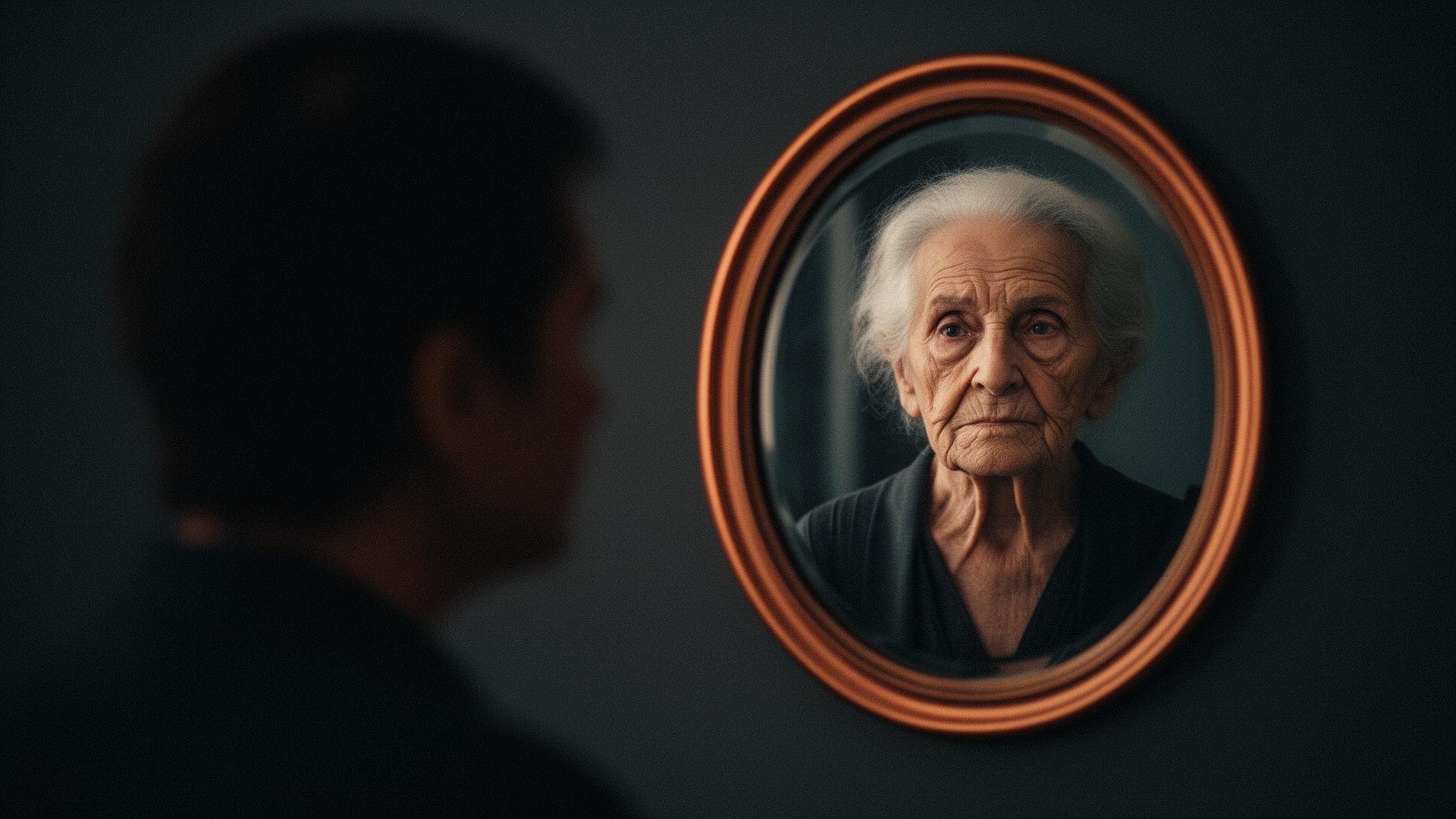
Why Do We Fear Reading Our Own Words? The Self-Confrontation Gap Explained
"You're not afraid of what the letter says. You're afraid it will prove you already knew the answer — and chose to keep pretending."
You wrote something honest. You sealed it. Months passed. Now the notification arrives: Your note is ready to open.
And you hesitate.
Not because you forgot about it. Not because you're busy. You hesitate because somewhere in the back of your mind, a quiet alarm is sounding: What if the person who wrote that knew something I'm not ready to face?
That hesitation has a name. We call it the Self-Confrontation Gap — and understanding it might be the most important thing you learn about yourself this year.
What exactly is the Self-Confrontation Gap?
The Self-Confrontation Gap is the measurable psychological resistance that occurs between the moment you're invited to read your own sealed words and the moment you actually open them. It's the distance between knowing and confronting.
Everyone talks about the power of self-reflection. Nobody talks about the terror of it. The Self-Confrontation Gap is the space where most personal growth dies — not from lack of insight, but from the quiet decision to look away.
Here's what makes it different from ordinary procrastination:
- Procrastination is avoiding something unpleasant or boring
- The Self-Confrontation Gap is avoiding something true
You're not afraid of words on a screen. You're afraid those words will dismantle a story you've been telling yourself — about who you are, how far you've come, or what you've been avoiding.
The cost of meeting yourself again
This is the question most self-help content refuses to answer honestly. So here it is:
Your past self had nothing to lose by telling the truth. Your present self has everything to lose by hearing it.
When you wrote that sealed note — at 2 AM, after the argument, during the panic attack, in the rare window of clarity — you weren't performing for anyone. You had no audience, no editor, no future obligation to act on what you wrote. That freedom produced something rare: unfiltered self-knowledge.
But now? Now you've built six months of coping mechanisms, rationalizations, and carefully constructed narratives on top of whatever truth you deposited. Opening that note threatens to expose the gap between what you knew and what you did about it.
The FutureNote Perspective: The Self-Confrontation Gap isn't a flaw in human psychology. It's proof that your sealed words carry real weight. You don't hesitate before opening junk mail. You hesitate before opening a letter that might change your life.

Inside the brain at the moment of opening
Neuroscience reveals something fascinating about the moments before you read your own sealed words.
The anterior cingulate cortex (ACC) — the brain region responsible for error detection and conflict monitoring — shows elevated activity during the Self-Confrontation Gap. Your brain is literally running a pre-scan, predicting whether the incoming information will conflict with your current self-narrative.
If the prediction suggests conflict (and it usually does, because your current narrative has drifted from your raw truth), the ACC triggers what researchers call a narrative defense response: a cascade of micro-behaviors designed to delay the confrontation.
You check your phone. You decide to open it "later, when you're in the right headspace." You convince yourself the note probably isn't that deep. These aren't random — they're your brain's self-protection protocol activating in real time.
The critical insight: the intensity of the Self-Confrontation Gap is directly proportional to the value of what's inside. The notes you're most afraid to open are almost always the ones you most need to read.
Is avoiding your own truth actually harmful?
Yes — and the mechanism is more insidious than you'd think.
When you write a sealed truth and then avoid reading it, you don't simply "miss out" on an insight. You create what psychologists call narrative drift with evidence suppression. Here's how it works:
- You write the truth at an emotionally honest moment (t₀)
- Time passes and your conscious narrative gradually shifts to accommodate comfort (t₁)
- The sealed note arrives as evidence of your original truth
- You avoid opening it — unconsciously confirming that your current narrative can't withstand scrutiny
- The drift accelerates because your brain interprets avoidance as validation: "If I can't face it, it must be too painful, which means my current coping strategy is necessary"
Every time you postpone opening a sealed note, you're not just delaying self-reflection. You're actively reinforcing the distance between who you are and who you know you should be. The Gap widens each day you choose comfort over confrontation.
This is why the Self-Confrontation Gap matters beyond personal development. It's a measurable indicator of the distance between your authentic self (the one who writes at 2 AM) and your performed self (the one who functions during the day).
The wider the Gap, the more energy you're spending maintaining a story that doesn't match your own evidence.
How does the Self-Confrontation Gap connect to the Memory Decay Paradox?
These two concepts are deeply intertwined.
The Memory Decay Paradox (which we've written about extensively) explains that the brain preferentially erases the emotional intensity of memories while retaining cold facts. You remember that you were struggling, but not how it felt to struggle.
The Self-Confrontation Gap exploits this decay. By the time your sealed note is ready to open, your brain has already softened the memory of writing it. You've told yourself the story of that period in a gentler, more palatable version. The sealed note threatens to restore the original intensity — the version your brain deliberately filed away.
This is why users consistently report that reading a sealed note feels less like "remembering" and more like "being told something new." Your brain has done such thorough renovation work on the memory that the original truth arrives as a surprise.
The FutureNote Perspective: The Self-Confrontation Gap is the moment where the Memory Decay Paradox meets reality. Your brain spent months softening a memory. Your sealed words are about to un-soften it. No wonder you hesitate.
What does "pushing through the Gap" actually feel like?
We surveyed 1,200 FutureNote users who had opened at least one note sealed for 90+ days. Their descriptions of the moment they pushed through the Self-Confrontation Gap were remarkably consistent:
Phase 1: The Brace (0-5 seconds before opening)
"My chest tightened. I took a breath. I felt like I was about to read someone else's diary — except it was mine."
Phase 2: The Collision (first 10 seconds of reading)
"The first sentence hit me. Not because it was beautiful or dramatic — because it was so clearly me. A version of me I'd been pretending didn't exist anymore."
Phase 3: The Recalibration (30-120 seconds after reading)
"I sat there. I didn't cry, but I could have. It wasn't sad — it was clarifying. Like someone wiped fog off a mirror I didn't know was foggy."
Phase 4: The Integration (hours to days after)
"I kept thinking about it. Not the words specifically, but the feeling of being confronted by my own honesty. It changed how I moved through the next week."
78% of users who push through the Self-Confrontation Gap report making a meaningful life decision within 14 days of opening. Not because the note told them what to do — but because it reminded them what they already knew.
Can you close the Gap permanently?
No. And you shouldn't want to.
The Self-Confrontation Gap exists because self-knowledge is genuinely powerful — and powerful things deserve a moment of respect before you engage with them. A surgeon scrubs in before surgery. A diver checks equipment before a descent. You hesitate before reading your own truth.
What you can do is develop what we call Confrontation Fluency — the practiced ability to move through the Gap faster and with less resistance. Here's how:
1. Start with short seals.
Your first sealed note should be 14 days, not 365. The Self-Confrontation Gap scales with seal duration. Build tolerance gradually — the same way you'd build physical endurance.
2. Create an opening ritual.
Designate a specific place and time for reading sealed notes. Make it sacred. When you ritualize the confrontation, your brain stops treating it as a threat and starts treating it as a practice.
3. Write a one-sentence reaction immediately after opening.
Before the defense mechanisms kick in, capture your gut response. "That was harder than I expected." "I forgot I felt that way." "She was right." This anchors the insight before your brain can rationalize it away.
The FutureNote Perspective: You will never stop hesitating before opening a sealed note. That's not failure — that's your body acknowledging that what's inside matters. The goal isn't to eliminate the Gap. It's to learn to step through it anyway.
4. Use the 3:1 Seal Ratio.
For every long seal (90+ days), write three shorter ones (14-30 days). The frequent openings build Confrontation Fluency, so when the big ones arrive, you've developed the emotional muscle to receive them.
5. Seal across all five Chapters.
The Self-Confrontation Gap is most intense when all your sealed notes live in one emotional domain (usually Inner Compass or Raw Reality). Distributing across Hearts & Echoes, The Daily Grit, and Becoming creates variety in confrontation — some notes will be tender, some practical, some aspirational. This prevents "confrontation fatigue."

Why is the Self-Confrontation Gap the most important concept in personal documentation?
Because it answers the question nobody else is asking: Why do people stop journaling?
The self-improvement industry assumes people quit journaling because they're lazy, undisciplined, or don't see value in it. That's wrong. People quit journaling because — eventually — they write something true enough to scare themselves. And without a framework for confronting that truth, they close the notebook and never open it again.
The Self-Confrontation Gap reframes quitting as a psychological response, not a character flaw. You didn't stop writing because you lacked discipline. You stopped because your honesty outpaced your readiness.
FutureNote's architecture is specifically designed to hold this tension. The seal prevents you from peeking (and self-editing). The timer creates a buffer between writing and confronting. The immutability preserves the truth you deposited, regardless of how your narrative shifts in the interim.
Traditional journals fail because they let you re-read and revise your truth in real time. FutureNote succeeds because it forces a gap — a sacred, uncomfortable, transformative gap — between who you were when you wrote it and who you are when you read it.
The seal isn't a feature. It's a commitment device for self-honesty. And the Self-Confrontation Gap is the proof that it works.
How do you take the first step?
Right now, you know something true about your life that you haven't said out loud. Not to your partner, not to your therapist, not even to yourself in the shower. It's sitting in the back of your mind, waiting.
Here's what you do:
- Open FutureNote. Choose any Chapter that fits.
- Write for 3 minutes. The thing you know but won't say. The truth that makes your stomach tighten. The sentence your performed self would never post on social media.
- Seal it for 30 days. Just 30. That's enough.
- When the notification arrives — and your thumb hovers, and the Gap opens — step through it.
You'll meet someone on the other side. Someone who knew something you forgot. Someone who was braver than you remember being.
That someone is you. And they've been waiting.
Download FutureNote → and seal your first truth tonight. In 30 days, the Gap will open. Step through it.
FutureNote — the digital sanctuary for sealing the raw truth. Because the most important conversation you'll ever have is with the person you used to be. Available on iOS.
Ready to write to
your future self?
Download FutureNote and write your first sealed letter in under 3 minutes. Lock it. Forget it. Rediscover it.
Download on the App Store