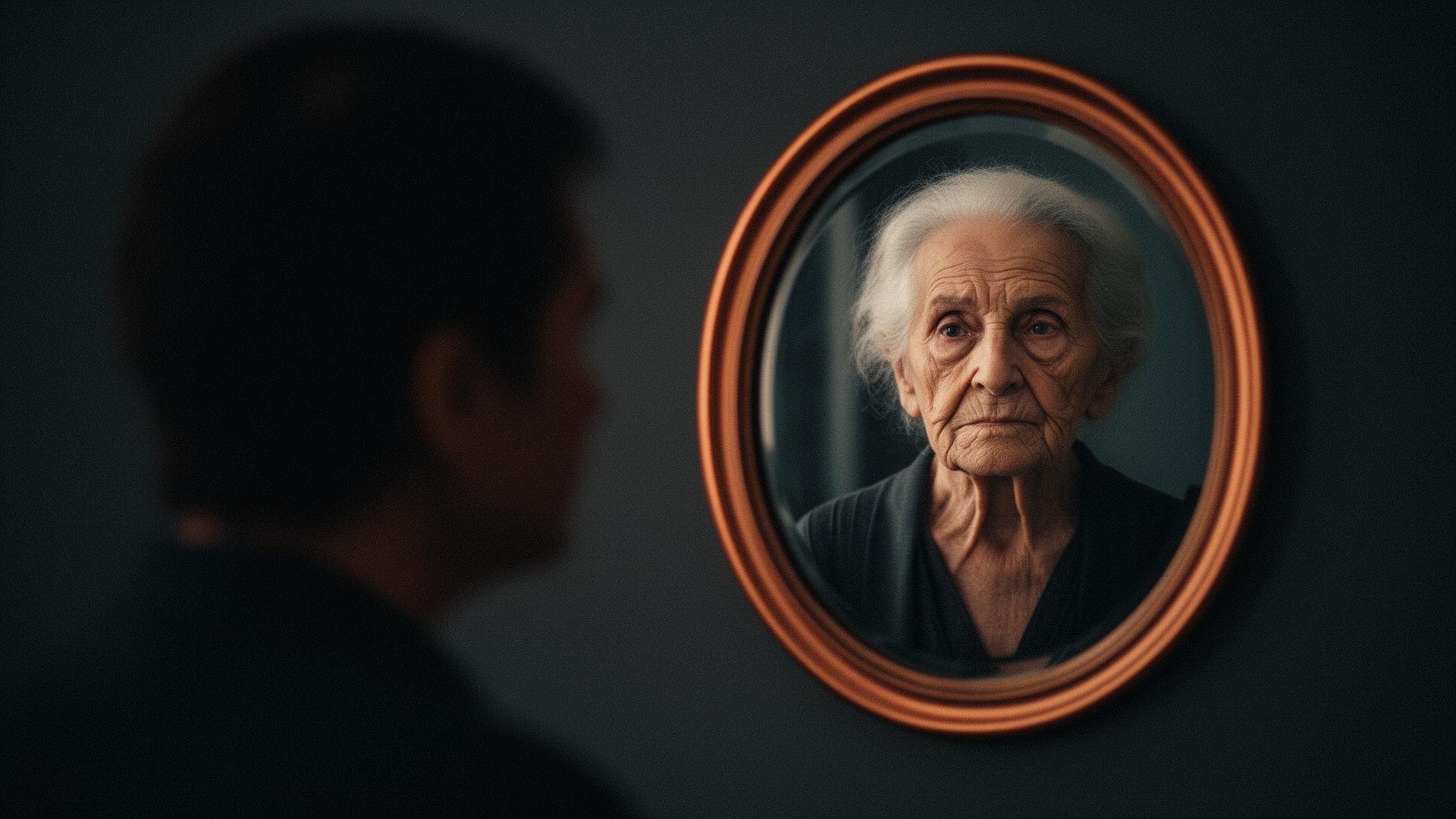
AI Knows Everything About You — Except the One Thing That Matters
"AI can finish your sentences. But it can't start the one you're afraid to write."
In 2026, artificial intelligence can predict your next purchase with 94% accuracy. It knows when you're about to break up before you do. It can detect early-stage depression from your typing patterns and forecast your career trajectory from your LinkedIn activity.
And yet.
There is a category of self-knowledge that no model — no matter how many parameters, how much training data, how sophisticated the architecture — will ever access. We call it the Untrackable Self.
What is the Untrackable Self?
The Untrackable Self is the layer of human identity that exists only in private emotional truth — the thoughts you've never typed into a search bar, never posted, never said aloud. It's the thing you know about yourself at 2 AM that vanishes by morning. The sentence that would change everything if you admitted it.
Every digital interaction you have — every search, swipe, like, and click — trains a model of "you." But that model is built from your performed self: the version curated for algorithms. The Untrackable Self is everything the performance leaves out.
AI models are trained on observable behavior. They see what you do, not what you mean. They see what you search for, not what keeps you awake. They see what you consume, not what consumes you.
Why can't AI access your real self?
This isn't a temporary limitation. It's structural.
AI prediction models work by finding patterns in externalized behavior — the digital exhaust of living. But the most important truths about a person are never externalized. They exist in what psychologists call the pre-verbal emotional substrate: the layer of knowing that sits beneath language, beneath behavior, beneath even conscious thought.
You know that feeling when someone asks "How are you?" and you say "Good" — but somewhere behind your sternum, something tightens? That tightening is the Untrackable Self. No keystroke captured it. No algorithm detected it. No recommendation engine will ever optimize for it.
The FutureNote Perspective: AI is getting better at predicting what you'll do. But the gap between what you do and who you are is widening — because the more time we spend performing for algorithms, the less time we spend confronting our own truth. The Untrackable Self doesn't need better technology. It needs a sanctuary.

How does AI prediction actually change your self-knowledge?
Here's the part nobody's talking about: AI doesn't just predict your behavior. Over time, it shapes it. And that shaping has a measurable effect on your relationship with yourself.
Researchers at Stanford's Human-Centered AI Institute documented a phenomenon they call Algorithmic Identity Collapse — the gradual process by which a person's sense of self becomes indistinguishable from their algorithmic profile.
Here's how it works:
- AI predicts what you'll enjoy, buy, watch, or read
- You accept the recommendation (because it's usually right)
- Your behavior increasingly mirrors the prediction
- Your sense of identity narrows to match the pattern
- Unexplored dimensions of yourself — the weird, contradictory, surprising parts — atrophy from disuse
The result? You become more predictable — not because the AI got smarter, but because you got smaller.
The cruelest irony of the AI age: the more accurately technology predicts who you are, the less accurately you know yourself. Because knowing yourself requires friction, surprise, and confrontation — exactly what algorithms are designed to eliminate.
What is the Prediction-Reflection Gap?
We've identified a measurable phenomenon in FutureNote users that we call the Prediction-Reflection Gap — the distance between what AI thinks you care about (based on behavior) and what you actually care about (based on sealed writing).
When users write sealed notes, they consistently write about topics that never appear in their digital footprint:
- The relationship they're staying in out of fear, not love
- The career they're pursuing for their parents, not themselves
- The grief they processed alone because posting about it felt performative
- The dream they abandoned because no one validated it online
These topics don't generate search queries. They don't produce social media posts. They don't trigger purchase behavior. They exist exclusively in the Untrackable Self — and they are, overwhelmingly, the topics that matter most.
The FutureNote Perspective: The Prediction-Reflection Gap proves something profound: the most important parts of your life are invisible to technology. Not because technology isn't advanced enough — but because the most important truths are the ones you only admit in private, in silence, in the dark.

Why is private writing the last competitive advantage?
In an economy where AI can replicate any skill, automate any workflow, and predict any preference, the only irreplaceable asset is self-knowledge that hasn't been captured by a model.
Think about it: if AI can predict your decisions before you make them, it can also influence them before you're aware. The only defense is a form of self-knowledge that exists outside the system entirely.
Private sealed writing creates what we call a Sovereign Knowledge Base — a record of your authentic self that no algorithm has trained on, no company has monetized, and no model can predict.
This isn't tinfoil-hat privacy paranoia. It's cognitive sovereignty: the ability to know something about yourself that no external system knows. And in 2026, it's becoming the rarest form of human agency.
In the 20th century, privacy was about keeping others from seeing your data. In 2026, privacy is about keeping yourself from being reduced to your data. The Untrackable Self isn't a luxury — it's the foundation of autonomous identity.
How does the Untrackable Self connect to the Memory Decay Paradox?
The Memory Decay Paradox explains that your brain erases the emotional intensity of memories within weeks, leaving only cold facts. AI makes this worse.
Here's why: when your memories live primarily in digital form (photos, posts, messages), they're already flattened. The algorithm shows you a "memory from 3 years ago" — but it's a curated, optimized version. The photo with the most likes. The post that performed best. Not the moment that mattered most.
Over time, your memory of an entire period of your life gets replaced by the algorithmic highlight reel. The messy, complicated, emotionally dense reality fades — replaced by a clean narrative that an AI assembled for engagement, not truth.
Sealed writing interrupts this process. When you write without an audience, without optimization, without the possibility of editing later — you create an unflattened memory. A record of emotional reality that no algorithm has touched.
The FutureNote Perspective: AI is not just predicting your future — it's editing your past. Every "memory" surfaced by an algorithm is a curated version designed for engagement. Sealed writing is the only form of personal documentation that preserves the full emotional resolution of a moment.

What does "Cognitive Sovereignty" look like in practice?
We asked 800 FutureNote users who maintain active sealing practices how their relationship with AI and technology has changed. The patterns were striking:
1. Decision Clarity
"I stopped asking ChatGPT for life advice. Not because it's bad at it — but because I realized I already had better advice sealed in a note from four months ago. My own advice, from a version of me who was actually living through the situation."
2. Algorithmic Resistance
"I noticed I was becoming my Spotify Wrapped. My sealed notes reminded me of a whole dimension of myself — interests, dreams, fears — that don't show up in any recommendation engine. That's the version I want to protect."
3. Temporal Anchoring
"AI shows me 'memories' from photos that performed well. My sealed notes show me moments that mattered. There's almost no overlap. That gap is terrifying — and exactly why I keep sealing."
Can you be yourself if an algorithm is always watching?
This is the philosophical question that underpins everything.
Behavioral psychology has known for decades about the Observer Effect: people behave differently when they know they're being watched. In 2026, you are always being watched — not by a person, but by systems that track, predict, and monetize every observable behavior.
The result is a permanent state of subtle performance. Not dramatic — you're not acting a role. But the micro-adjustments are constant: you pause before typing a search query that feels "embarrassing." You draft a post, then delete it because it doesn't match your "brand." You swipe past content you're curious about because the algorithm might "misunderstand" you.
This is the slow erosion of the Untrackable Self. Not through censorship, but through ambient self-editing — the unconscious process of curating yourself for systems that are always inferring.
You don't need to be paranoid about surveillance to understand the problem. You just need to ask yourself: when was the last time you thought something — really thought it — without wondering how it would look as a post, a search, or a message? The Untrackable Self lives in that gap. And for most people, the gap is closing.
Sealed writing reopens it. When you write inside FutureNote, there is no algorithm watching. No recommendation engine learning. No model training. The note is encrypted, sealed, and invisible until the timer expires. For those few minutes of writing, you are genuinely unobserved — possibly for the first time all day.

How do you start building your Untrackable Self?
The practice is simple. The implications are profound.
1. Write one thing AI doesn't know about you.
Open FutureNote. Choose Raw Reality or Inner Compass. Write the thought you've never searched for, never posted, never told anyone. The one that lives only in your head. Seal it for 30 days.
2. Use the Prediction-Reflection Test.
After you write, ask yourself: Would any AI system have predicted I was thinking about this? If the answer is no — congratulations. You just documented a piece of your Untrackable Self. You just created data that no model owns.
3. Read sealed notes before asking AI for advice.
The next time you're about to ask ChatGPT "What should I do about my career?" — pause. Open your sealed notes first. The version of you who wrote during the actual experience almost certainly left better advice than a model trained on everyone else's experience.
4. Maintain the 3:1 Seal Ratio.
For every long seal (90+ days), write three short ones (14-30 days). This keeps you in regular contact with your Untrackable Self — the part of you that exists below the algorithmic surface.
5. Protect the gap.
Don't screenshot your sealed notes. Don't post about what you wrote. Don't feed your private truths back into the system. The whole point is to have a dimension of identity that exists outside the observable. That's not secrecy — it's sovereignty.
The FutureNote Perspective: In 2026, the most radical act of self-care isn't meditation, therapy, or a digital detox. It's writing something true in a place no algorithm will ever see — and trusting your future self to receive it. That's not journaling. That's cognitive sovereignty.
Why does this matter more in 2026 than ever before?
Because the window is closing.
As AI systems become more sophisticated, the boundary between "predicted self" and "actual self" will continue to blur. The generation growing up with AI assistants, AI tutors, and AI therapists may never develop an Untrackable Self at all — because they'll never experience the friction of being unobserved.
This isn't dystopia. It's drift. The quiet, comfortable narrowing of human identity to match what's measurable. And the only antidote is deliberate, private, unoptimized self-confrontation.
FutureNote exists for this exact moment. Not as a productivity tool. Not as a wellness app. As a sanctuary for the part of you that algorithms can't reach — the raw, unfiltered, contradictory, messy truth that makes you irreducibly you.
The AI knows your patterns. Your sealed notes know your soul. Only one of those will still matter in ten years.
Download FutureNote → and write the one thing no algorithm knows about you. Seal it. In 30 days, you'll meet the version of yourself that exists beyond prediction.
FutureNote — the digital sanctuary for your Untrackable Self. Because the most important data about your life is the data no model will ever see. Available on iOS.
Ready to write to
your future self?
Download FutureNote and write your first sealed letter in under 3 minutes. Lock it. Forget it. Rediscover it.
Download on the App Store